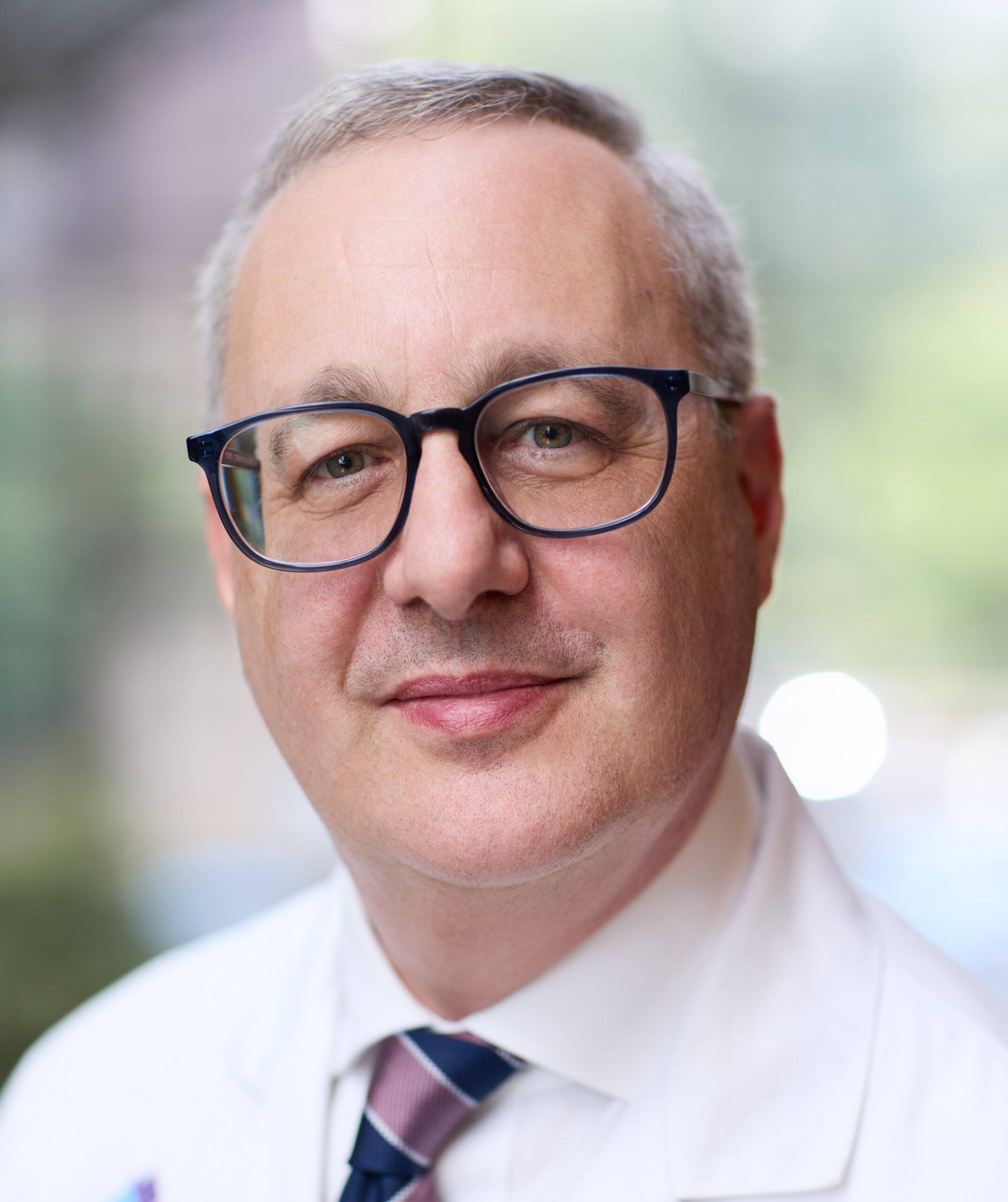
Dr. Burrill B. Crohn Professor of Medicine, Icahn School of Medicine at Mount Sinai; Chief, Division of Gastroenterology, Icahn School, Mount Sinai Health System, New York, NY

When Dr. Sands was six years old, his parents gave him a working stethoscope and microscope, igniting a passion for science. He was captivated by looking at slides to see details that were hidden from the naked eye. From that time on, he says, he was hooked on science and the idea of pursuing a career in medicine. In medical school, he was drawn to the field of gastroenterology, fascinated by the complex interplay between the muscular, neurologic, and immune systems.
Fast forward to today, and Dr. Sands has become a world-renowned expert in IBD clinical trial design who has helped enable the development of nearly every modern medicine for IBD and reshaped the therapeutic landscape of IBD, expanding options for patients who once had few effective choices.
As a Fellow at the Massachusetts General Hospital, he was at the forefront of the biologic revolution when he seized an opportunity to serve as an investigator on the first randomized controlled trial of infliximab. The trial was successful and this medicine ultimately became the first approved biologic in IBD, setting a new standard for patient care. When the study was unblinded, Dr. Sands saw the promise of clinical research come to life: his patients who had received the study drug were experiencing dramatic responses. The experience showed him the power of research to make an immediate, tangible difference in patients’ lives.
“Seeing our trial directly help patients was a transformative experience; it launched my lifelong commitment to IBD research.”
Since then, Dr. Sands has been relentlessly pushing the boundaries of IBD research, pursuing innovative medicines to improve outcomes for his patients. Most notably, he has led, co-led, or been a key investigator for trials that have established the efficacy and safety of multiple new classes of IBD treatments – including anti-TNF, anti-integrin (IV and oral anti-α4β7), anti-IL-12/23, selective IL-23p19 inhibitors, JAK inhibitors, S1P modulators, and anti-TL1A. Collectively, these medicines represent incredible advances in care for people living with IBD.
What has kept Dr. Sands moving from one frontier to the next is a characteristic that has defined his career from the beginning: he is rarely satisfied with simply knowing that something works. He wants to know what comes next—and whether it can work better.
As more and more novel medicines for IBD have become available, Dr. Sands has pushed research in another new direction – answering the question of which of these medicines are most effective. In search of such answers, he led the first head-to-head trial in IBD – the field-changing VARSITY study that established vedolizumab was more effective than adalimumab in people with moderate to severe ulcerative colitis.
Last year, he published additional head-to-head studies, GALAXI-2 and GALAXI-3, which established that guselkumab was superior to ustekinumab (the standard of care) in patients with moderate to severe Crohn’s disease. Together, these head-to-head studies provide greater clarity for treatment decision-making.
More recently, Dr. Sands has been exploring another first: precision medicine approaches to provide more tailored care. In the past year, he published the results of ARTEMIS-UC, a Phase 2 trial that studied whether a companion diagnostic could predict response to an investigational treatment called tulisokibart. This anti-TL1A agent shows promise for targeting both inflammation and fibrosis, drivers of disease activity and progression in Crohn’s disease and ulcerative colitis.
While the study showed superiority of tulisokibart over placebo, it did not show that the biomarker in the companion diagnostic identified patients more likely to have a response. Even though the results were mixed, the study is still very important to the field. For Dr. Sands, even an unexpected result can point the way toward the next discovery.
“We learned a lot from this study that will be applied to future research as we endeavor to more precisely deliver the right medicines to the right patients.”
Another emerging area of Dr. Sands’ research focus is the exploration of combination therapy in IBD – the idea of combining medicines to try to achieve better results than one medicine can provide alone. Combination therapy is commonly used in other diseases, such as cancer. Now Dr. Sands is studying whether this approach can also work in IBD – diseases which have many different pathways. By addressing multiple pathways at the same time, the goal is to improve on the low rates of clinical remission seen with monotherapy.
Dr. Sands was the senior investigator and second author on the first randomized proof-of-concept of biologic combination therapy in IBD, a Phase 2 study called VEGA published in 2023. This early-stage study showed that a combination of two medicines may be more effective in ulcerative colitis than either medicine alone. Building on this work, Dr. Sands was the co-author of DUET-UC and first author of DUET-CD, parallel Phase 2b studies that evaluated a combination of guselkumab and golimumab, compared to each medicine alone, in people with ulcerative colitis or Crohn’s disease, respectively, who had failed prior advanced therapy. These studies showed that combination therapy could make remission possible for patients who haven’t been able to achieve it with other treatments.
“This study offers hope in today’s landscape in which each successive IBD therapy produces diminishing returns and patients who have failed multiple treatments have very limited options.”
Underlying all of Dr. Sands’ research is his determination to help patients who haven’t benefited fully, or at all, from recent IBD treatment advances. His most difficult cases are the individuals who have experienced improvement but then their treatment stopped working, or those who have cycled through medicine after medicine but have never been able to achieve disease remission. He says that oftentimes he’s sought out as a consultant of last resort. The trust patients and physicians place in him is a testament to his expertise—but it also speaks to what keeps him going. The harder the case, the more determined he is to find an answer.
Dr. Sands’ hope and belief is that all the work he and his teams are doing – studying novel mechanisms of action, precision medicine, combination therapies, making studies more efficient – will enable them to deliver more effective treatments, faster, to patients in need.
For someone whose research has influenced the treatment of millions of patients, Sands speaks about his work with striking humility, returning again and again to the individual patients who inspire it.
“I’m in the fight alongside my patients, and I tell them that I’m a perfectionist and won’t stop until they’re feeling perfect – that’s what drives my research.”
While Dr. Sands continues to pursue innovative areas of research to try to improve patients’ lives, he sees mentoring and education as central to this mission. He has served as the Chairman of the International Organization for the Study of IBD and as Associate Editor of the peer-reviewed medical journals Gastroenterology and Inflammatory Bowel Diseases. Through these avenues, he helps ensure that clinical research findings are broadly shared and that forums for discussion help advance best practices in research and care.
Dr. Sands is a builder. Since he took over as Chief of the Dr. Henry D. Janowitz Division of Gastroenterology at Mount Sinai Health System in 2010, he has not stopped building piece by piece what is now considered one of the leading IBD centers in the world by supporting the recruitment of other complementary key opinion leaders in IBD and fostering within his division the emergence of a new generation thought leaders.
Even with all of the groundbreaking medical advances he has helped deliver to patients so far, Dr. Sands is quick to shift the focus away from himself and toward the people he has mentored and says he is most proud of the global pipeline of clinician-scientists he has helped train.
Under his leadership, his junior faculty members are engaged in diverse areas of study: how do early life events impact the risk of developing IBD, how can wearables help in monitoring IBD to improve outcomes, what are the determinants of pouchitis, a common complication after surgery for ulcerative colitis. He sees their research findings and achievements, as well as the lives he’s changed through his own research, as the ripple effect of his work.
“The acceleration in IBD therapeutics over the past decade has been remarkable and the future of IBD can be transformative if we make trials more efficient, treatments more targeted, and monitoring more continuous, and I am committed to that agenda, and to mentoring the next generation of IBD clinician-scientists to carry it forward.”
For Dr. Sands, the excitement is not only in making a discovery, but in seeing where it leads. That same unwavering pursuit drives his commitment to mentoring those who will shape the future of IBD, bringing new questions, new possibilities, and new ideas to the field. He sees this ripple effect as part of a continuing story – his legacy as a physician-scientist who is always questioning, always innovating, and always searching in service of the patients who need his help.